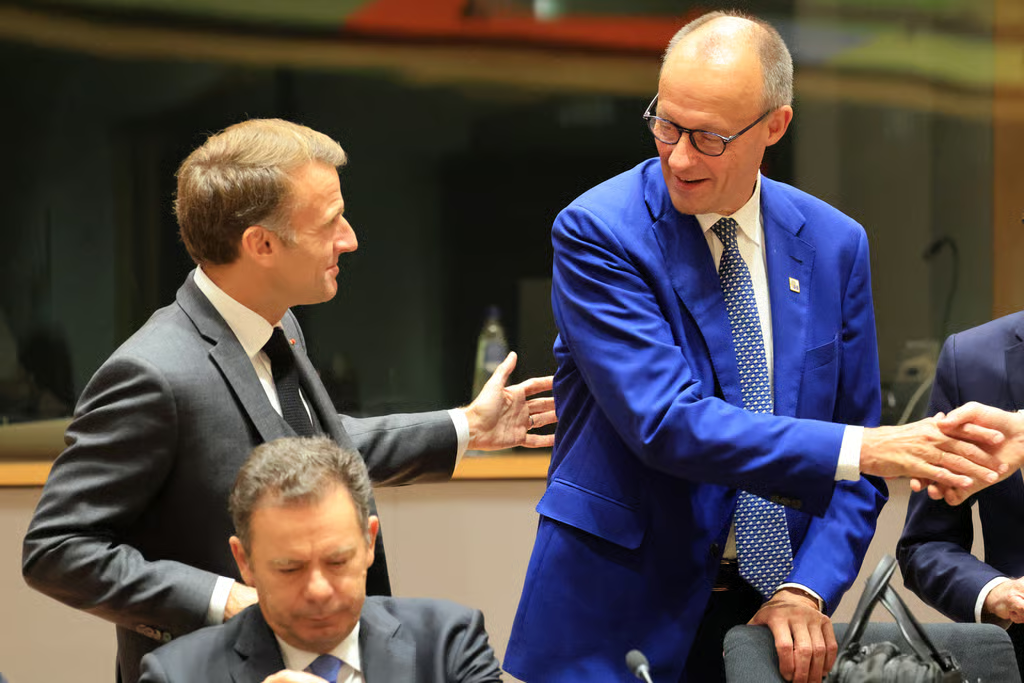
The compromise was reached after the German Social Democrats, the junior coalition partner in Friedrich Merz’s government, dropped their opposition.
AI generated Text-to-speech
BRUSSELS — France and Germany said Friday they had struck a deal to favor European-made cars under a landmark EU industry bill in exchange for weakening a 2035 vehicle emissions target, ending months of wrangling between the bloc’s two biggest economies.
Under the agreement, Germany would accept stricter “Made in Europe” — or local content — requirements for the automotive industry in the proposed Industrial Accelerator Act, a longstanding French demand, while France would back Berlin’s push to relax the EU’s plan to phase out new combustion-engine cars.
The EU’s current target is for companies to reduce emissions from new vehicles by 100% from 2021 levels by 2035, with the possibility to “earn” 10% of emissions leeway through initiatives like offsets and investments.
France and Germany now want to soften the 2035 target to 90% but without having to offer investments in alternative fuels to compensate the remaining 10%, as proposed by the European Commission.
“This balanced approach will enable the European Union to pursue its climate objectives while strengthening the technological sovereignty, industrial base and international competitiveness of its automotive industry,” the two countries said in a joint statement.
The agreement, first reported by POLITICO in July, was due to have been announced Thursday, during a meeting of EU leaders in Brussels. But it was held up at the last minute by disagreements within Germany’s governing coalition.
“We hope that this Franco-German dynamic can swiftly lead to an agreement with our partners, for our jobs and our industry,” French President Emmanuel Macron said in a post on social media.
An Elysée official on Friday made clear that, under the Franco-German deal, the scope of Made in Europe for automotive can be extended to the U.K. and Switzerland under certain conditions. — addressing a key concern of Prime Minister Andy Burnham’s government ahead of a Nov. 20 U.K.-EU summit in Brussels.
The agreement was reached after the German Social Democratic Party, the junior partner in Chancellor Friedrich Merz’s coalition government, dropped its opposition.
“This is a modern realignment of German industrial policy that places significantly greater emphasis on preserving jobs and production sites,” said German Environment Minister Carsten Schneider, who is from the SPD.
“The clear expectation for German companies is that they will use these new opportunities to make investments and guarantee jobs here in Germany,” he added.
CORRECTION: This article was updated on Oct. 16 after an earlier version misrepresented the figures in the Franco-German proposal on the softening of 2035 targets.
Leaders left crucial decisions on the bloc’s long-term budget and Ukraine’s financial needs to further gatherings in November and December.
The draft pact supports tighter eligibility rules for non-EU countries to participate in public procurement and public support, and softens the 2035 combustion engine ban.
Starting from January, there will be no political room for concluding an agreement, French president tells summit.
The French and German leaders face political pressures that limit their room for maneuver on Europe’s biggest negotiation.